


© Greg Lavaty
Ruddy Turnstone
Arenaria interpres
Family: (Scolopacidae) Sandpipers, Phalaropes and Allies
Preferred Habitat: Beaches, mudflats.
Seasonal Occurrence: Common fall through spring; uncommon in summer.
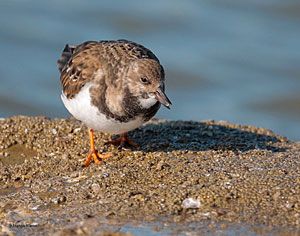
Profile by Bryce Loschen: The Ruddy Turnstone is the calico cat of shorebirds. In the breeding season, both males and females have bright orange legs, an orange-and-black patterned back, white belly, and black-and-white face. As if not yet distinctive enough, a Ruddy Turnstone in flight gives off more clues to ID them, including a white stripe that runs down their back, a white rump, and a black stripe on their tail. The nonbreeding plumage resembles the breeding plumage, but replaced with brown rather than the distinct orange and black. The dark brown chest patch is especially noticeable in the nonbreeding season.
Ruddy Turnstones have acquired their name for an oftentimes overlooked reason: they feed on adult and larval flies by turning over stones along coastlines. Among stones, they will also flip over any other item that can shelter these insects: shells, seaweed, etc. Their bill is stout and slightly upturned, therefore perfectly outfitted for this feeding behavior.
During the breeding season, Turnstones will stick to a strict diet of flies and midges, but they are willing to expand their palate during the nonbreeding season, as they are long distance migrants and need as much fuel as they can get. They breed in the Arctic tundra along rocky shorelines and in North American tundra among bodies of water such as marshes and ponds. They will use beaches, mudflats, and freshwater shorelines as rest stops during migration, which makes Bolivar Flats a near guarantee for a Ruddy Turnstone sighting (and sometimes dozens!).
© Joanne Kamo
Profile by Kayla Kutka: The Ruddy Turnstone is a small calico-colored shorebird with a stout, slightly upturned black bill and distinct orange legs that are brighter during breeding season. They use their strong neck and bill to flip stones, shells, or seaweed in search of small invertebrates and insects, hence where the name “turnstone” comes from. Ruddy Turnstones are mostly found on biologically productive rocky coasts or sandy beaches with washed-up seaweed or visible reefs perfect for foraging.
Ruddy Turnstones are one of the most northerly breeding shorebirds. They migrate yearly from the Arctic Circle to tropical coastlines, some traveling upwards of 6,500 miles between their breeding and non-breeding grounds. Excluding the breeding season in the Arctic, the Ruddy Turnstone can be found on coastlines throughout the world. Their estimated global population is 750,000 to 1,750,000 mature individuals, with the North American population making up about 59% of the global total.
During breeding season, Ruddy Turnstones have vibrant orange and black colors, with more dull grays and browns when non-breeding. From late May to early August, these shorebirds are breeding on coastal plains or lowlands around the Arctic Ocean. In the winter, they are prevalent in the coastal areas of South America, Africa, the Pacific Islands, and the Northern Hemisphere. As for our Texas coastlines, Ruddy Turnstones can be found year-round. Although they are less likely during the summer months, they can be consistently spotted at Bolivar Flats Shorebird Sanctuary from fall to spring in their non-breeding plumage.

© Greg Lavaty

© Greg Lavaty

© Greg Lavaty