

Eastern Gamagrass

© Mike Haddock, Kansas State University
Tripsacum dactyloides
Family: Poaceae (Grass Family)
Eastern Gamagrass (Tripsacum dactyloides) is a robust, clump-forming native grass found throughout Texas, including moist prairies and riparian zones. Known for its exceptional forage value and erosion control benefits, this species is a vital component of native grassland ecosystems.
- Common Names: Eastern Gamagrass, Fakahatchee Grass
- Family: Poaceae (Grass Family)
- Growth Habit: Clump-forming, warm-season perennial
- Height: 3-8 feet
- Leaves: Broad, arching, bright green
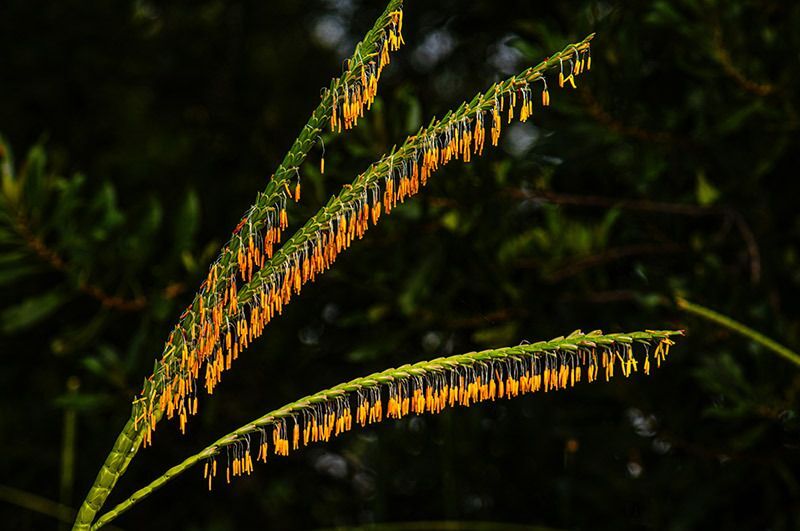
- Flowers: Distinctive red and yellow spikelets
- Bloom Time: Late spring to summer
- Wildlife Benefits: Excellent forage for livestock and habitat for pollinators
Habitat & Range in Southeast Texas

© Mike Haddock, Kansas State University
Eastern Gamagrass is commonly found in:
- Riparian Zones & Moist Prairies: Prefers well-drained to seasonally wet soils
- Grasslands & Roadsides: Establishes well in native prairie restorations
- Pastures & Agricultural Fields: Grown for livestock forage due to its high nutritional value
Ecological Importance
- Erosion Control: Deep roots stabilize soil and improve water infiltration.
- Wildlife Habitat: Provides food and cover for pollinators, birds, and small mammals.
- Forage Value: One of the most nutritious native grasses for livestock grazing.
Landscaping & Gardening Uses
Eastern Gamagrass is an excellent choice for pasture improvement, conservation efforts, and native landscaping:
- Prairie & Riparian Restorations: Enhances biodiversity in moist grasslands.
- Erosion Control: Deep roots prevent soil loss in flood-prone areas.
- Low-Maintenance Landscaping: Drought and flood-tolerant with minimal upkeep.
Planting & Care
- Sunlight: Full sun to partial shade
- Soil: Adaptable; prefers well-drained to moist soils
- Water Needs: Moderate; tolerates drought and seasonal flooding
- Maintenance: Low; occasional trimming to manage growth
- Companion Plants: Pairs well with Little Bluestem (Schizachyrium scoparium), Black-eyed Susan (Rudbeckia hirta), and Indian Grass (Sorghastrum nutans)
Fun Facts
- Eastern Gamagrass is closely related to corn and was historically used as a food source by indigenous peoples.
- It is one of the most nutritious native grasses for grazing livestock.
- Its deep root system improves soil health and reduces compaction.
Conservation & Native Plant Advocacy
Incorporating Eastern Gamagrass into landscapes supports soil health, improves water retention, and provides valuable forage for both wildlife and livestock. It is a key species in prairie restoration efforts.
Where to Find It
-
Interested in adding Eastern Gamagrass to your garden? Check if this is in stock or add to cart to purchase directly from our Natives Nursery.
Notes
By Flo Hannah. Written for the January/February 2007 issue of The Naturalist.
Eastern Gamagrass is found in the low-lying areas of the coastal prairie in association with Switchgrass (Panicum virgatum). Both are native grasses that are exceptionally large, beautiful components of our prairies. Eastern Gamagrass is an ancestor to maize. When it flowers (late March to early October) it has interesting red spikes consisting of separate male and female spikelets. Grass spikelets hold the fruit or grain of grasses for reproduction. When the female spikelets are mature, they break apart like pop-beads that resemble small kernels of corn.
Eastern Gamagrass provides excellent wildlife habitat; the spreading clumps are often hollow in the middle, forming a tented canopy of leaves growing from the ring of rhizomes and falling into the center. This hollow center is extremely large and makes excellent nesting sites for ground-dwelling birds such as quail and prairie-chickens and excellent overwintering cover for grassland sparrows.
Eastern Gamagrass can tolerate both long periods of flooding and drought. This tough, hardy grass has thick, rhizomatous roots that make it an excellent bank stabilizer in erosion control projects. The City of Austin uses it extensively to stabilize creek banks. It is an elegant and dynamic plant found in both partial shade and full sun. The Nash Prairie near West Columbia has a lovely stand of Eastern Gamagrass in a low-lying depression. I’ve also found it on the forest’s edge at Bobcat Woods (San Bernard NWR), along SH 124 near High Island, Memorial Drive near Rummel Creek, at the Brazos River Turnaround on I-10, and basically throughout the Gulf Coast in undisturbed low areas. Keep a lookout for it - it’s worth searching for.
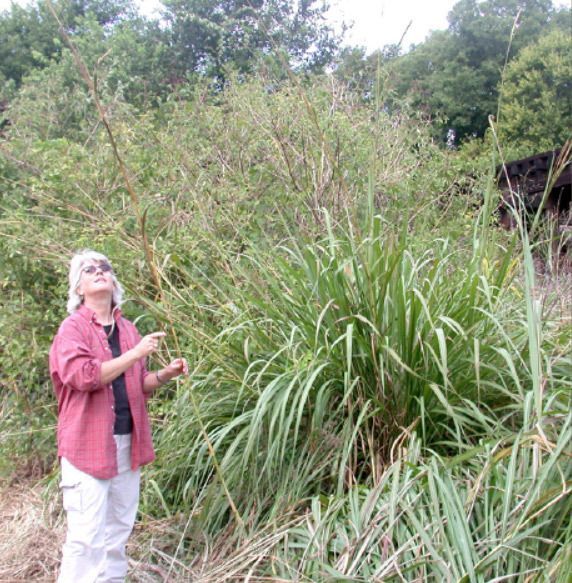
Flo with an exceptionally large specimen found at the Brazos River Turnaround. She is holding a stem with inflorescence which is about twice her height.
© Joe Liggio