

American Beautyberry

© Susan Billetdeaux
Callicarpa americana
Family: Verbenaceae (Verbena Family)
American Beautyberry is an attractive shrub with graceful arching branches. It is tolerant of a wide range of soils, including sandy, loam, and clay. It tolerates full sun in moist conditions.
- Scientific Name: Callicarpa americana
- Common Names: American Beautyberry, French Mulberry
- Family: Verbenaceae (Verbena Family)
- Growth Habit: Shrub
- Height: Up to 9 feet. Prune in the winter.
- Leaves: Green
- Flowers: Pink
- Bloom Time: May through July
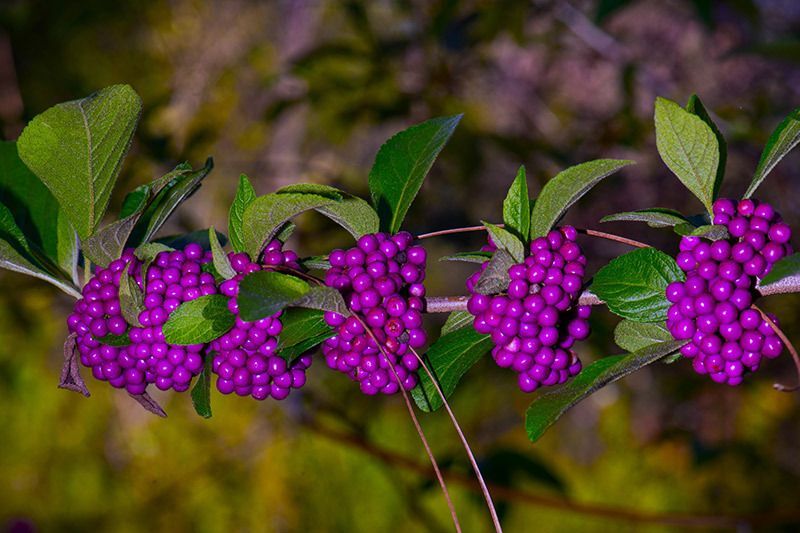
- Wildlife Benefits: The blossoms attract native bees. The purple berries are avidly consumed by many species of birds, including mockingbirds, cardinals, and finches, as well as other wildlife.

Eric Hunt, CC BY-SA 3.0 , via Wikimedia Commons
Where to Find It
-
Interested in adding American Beautyberry to your garden? Check if this is in stock or add to cart to purchase directly from our Natives Nursery.
Notes and Tips
American Beautyberry is a native deciduous shrub that combines spring flowers and beautiful fall fruit, making it a good choice for native landscaping. The shrub grows to 9 feet with large, 6-8 inch serrated (toothed) green leaves. Clusters of tiny lilac flowers appear in the spring in the leaf axils (where the leaf joins the stem). In late August berrylike drupes appear in bright shades of purple. The berries are packed tightly together in clusters that encircle the stem. American Beautyberry prefers partial shade and well-drained soils. It is wonderful food for wildlife. The colorful berries are eaten by a variety of birds including mockingbirds and bobwhite quail.
-- Flo Hannah. Written for the May/June 2007 issue of The Naturalist
American Beautyberry reseeds easily, so if you add one to your garden, you will soon have volunteers. Move seedlings to the desired location while they are still quite small (only a few leaves). Older plants set down taproots and are difficult to transplant.
Older plants tend to sprawl but readily accept pruning if your space is limited. Summer growth produces a second crop of berries for hungry wildlife.
© Joe Liggio